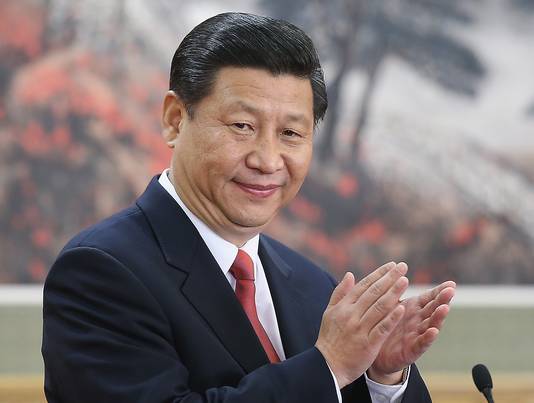
While the new Party leader in China can't say "rule of
law," he did talk about keeping power within a "cage." Perhaps
Chinese dissidents should talk about cages rather than constitutions.
Reformers
Aim to Get China to Live Up to Own Constitution
After the chaos of the Cultural Revolution, the surviving
Communist Party leaders pursued a project that might sound familiar to those in
the West: Write a constitution that enshrines individual rights and ensures
rulers are subject to law, so that China would never again suffer from the
whims of a tyrant.
The resulting document guaranteed full powers for a
representative legislature, the right to ownership of private property, and freedoms
of speech, press and assembly. But the idealism of the founding fathers was
short-lived. Though the Constitution was ratified in 1982 by the National
People’s Congress, it has languished ever since.
Now, in a drive to persuade the Communist Party’s new
leaders to liberalize the authoritarian political system, prominent Chinese
intellectuals and publications are urging the party simply to enforce the
principles of their own Constitution.
The strategy reflects an emerging consensus among advocates
for political reform that taking a moderate stand in support of the
Constitution is the best way to persuade Xi Jinping, the party’s new general
secretary, and other leaders, to open up China’s party-controlled system. Some
of Mr. Xi’s recent speeches, including one in which he emphasized the need to
enforce the Constitution, have ignited hope among those pushing for change…
Through the decades, party leaders have paid lip service to
the Constitution, but have failed to enforce its central tenets, some of which
resemble those in constitutions of Western democracies. The fifth article says
the Constitution is the supreme authority: “No organization or individual may
enjoy the privilege of being above the Constitution and the law.” Any real
application of the Constitution would mean severely diluting the party’s power.
It is unclear whether the latest push will be any more
successful than previous efforts…
Deng Yuwen, an editor at Study Times, said he had so far
only seen talk from Mr. Xi. “We have yet to see any action from him,” Mr. Deng
said. “The Constitution can’t be implemented through talking.”
And since taking power, Mr. Xi has appeared more concerned
with maintaining party discipline than opening political doors. In remarks made
during a recent southern trip that have circulated in party circles, Mr. Xi
said China must avoid the fate of the Soviet Union, which broke apart, in his
view, after leaders failed to stick to their socialist ideals and the party
lost control of the military…
Nonetheless, talk of constitutionalism has become daily fare
on literati Web sites like Gongshiwang, a politics forum. Typical was a Jan. 24
essay that ran on the site by Liu Junning, a political scientist, who seized on
Mr. Xi’s most recent remarks on “caging power” and traced the concept to the
Magna Carta and the American Constitution.
“Constitutional governance is restricted governance,” Mr.
Lui wrote. “It is to tame the rulers. It is to shut the rulers in a cage.”
Thanks to Kristan Crawford for finding this link from The Guardian UK about the linguistic standard of the presidential addresses has declining. The State of our State of the Union is apparently much dumber. Using the Flesch-Kincaid readability test the Guardian has tracked the reading level of every state of the union.
From the high average reading level (21.6) of addresses given by James Madison to the lowest average reading level, George Herbert Walker Bush (8.6) some interesting analysis here .
However, while maybe lacking high linguistic level, the White House boasted last night's speech as having never before seen enhancements, including charts, graphs and interactive discussions with policy administrators.
Below is a word cloud from last night's SOTU address:
In the Soviet Union (and Tsarist Russia before it) any organization, from stamp
collectors to football players, from knitters to gardeners, was run by the
government (or the Communist Party in the USSR). In the People's Republic of
China, any organization outside the Party or the government is suspect and
likely to be persecuted.
Independent civil society is a threat to the
power and control of the powers that be. In Putin's Russia, as surveillance,
nationalism, obedience, and official religion are becoming more and more
important, uncontrolled civil society organizations are less and less welcome.
A country doctor, a tiny, dilapidated village hospital, an
indifferent health bureaucracy — and now, coming to the rescue, volunteers from
distant Moscow, bringing furniture, equipment, money and, maybe most important,
good cheer.
In the background, though, is the parliament — weighing a
law to bring any volunteer activity under the purview of the state, on the
theory that people who organize themselves to do good work are a threat to the
state’s power.
The past year or so has seen an upwelling of a trend
unprecedented in Russia — people getting together on their own to help others in
need. Personal initiative, always suspect here, is suddenly taking off…
The rapid emergence of volunteer efforts, fueled in large part by social
media, coincides with the eruption of public political protest — and that’s not
by happenstance. There is an overlap between the political opposition and those
who have become fed up with a corrupt government that delivers little and who
have decided to take matters into their own hands.
Legislation to
regulate volunteers has been introduced in the State Duma, or lower house of
parliament, by President Vladimir Putin’s United Russia party. Backers say it
will ensure that volunteer activity conforms to the government’s priorities and
doesn’t conflict with Kremlin policy.
Officials aren’t the only ones
hostile to volunteerism. Russia’s Soviet past, when the government controlled
all aspects of life, has left it with a population that is accustomed to the
idea that the government should provide for its citizens and that is suspicious
of volunteer organizations. A 2012 poll found that more than half the population
disapproves of them...
As we begin our
look into the Post-Communist World, we need to start with the basics in this
three part intro assignment:
Part One:
In your C6
(5) CountryGroups, Access the constitutions of current day Russia and China and
create a compare/contrast chart with the U.S. Constitution. List and explain a
minimum of 5 comparisons and 5 contrasting observations. (similar to what we did
for Great Britain).
You will write an "I am not a Marxist" essay from the
eyes of three leading Communist leaders. I will explain in
class. DON'T HAVE TO DO
______________
From Political Warrior
(3/1/11)
Unsettling? Foreign Policy reports on how Russia,
China...and the U.S. view events in Egypt:
One of the principal bases
of U.S. foreign policy under President Barack Obama has been to create as
constructive relations as possible with Russia, China, and other great powers.
The administration had some degree of success in 2010: notably the Russia
"reset" policy and managing inevitable trade and other tensions with rising
China. But 2011 looks set to be more challenging as events continue to unfold in
Egypt after the mass demonstrations that ousted President Hosni Mubarak and as
the United States, Russia, and China all prepare for elections in 2012.
The populist revolutions in the
Middle East are prompting reactions in China. The reactions illustrate the fears
of the authoritarians in China.
Well-Oiled Security Apparatus in
China Stifles Calls for Change
Two months of upheaval in the
Mideast have cast doubt on the staying power of all authoritarian governments.
But in China calls for change are so far being met with political controls
wielded by authorities who, even during a period of rising prosperity and
national pride, have not taken their staying power for granted.
The
nearly instantaneous deployment of the police to prevent even notional
gatherings in big cities the past two weeks is just one example of what Chinese
officials call “stability maintenance.” This refers to a raft of policies and
practices refined after “color revolutions” abroad and, at home, tens of
thousands of demonstrations by workers and peasants, ethnic unrest, and the
spread of mobile communications and broadband networking.
Chinese
officials charged with ensuring security, lavishly financed and permitted to
operate above the law, have remained perpetually on edge, employing
state-of-the-art surveillance, technologically sophisticated censorship, new
crime-fighting tools, as well as proactive efforts to resolve labor and land
disputes, all to prevent any organized or sustained resistance to single-party
rule...
Chinese Move to Stop Reporting on
Protests
Chinese police, citing newly
enacted restrictions on journalists, have moved to forcefully prevent foreign
reporters from covering public protests that have been largely nonexistent,
establishing “no reporting” zones in Shanghai and Beijing and, in one case,
beating a videographer and injuring two other reporters…
Why
China Is Nervous About the Arab
Uprisings?
As protests swept the Arab
world, toppling two regimes, the Chinese government has strengthened its
elaborate security apparatus with crackdowns on human rights lawyers and
activists.
On the Chinese Internet, anonymous calls for a "Jasmine
Revolution" -- modeled after the pro-democracy demonstrations in the Middle East
-- have been squelched by authorities. Words like "Egypt" and "Tunisia" have
been blocked on some Web searches and social networking sites have been made
inaccessible.
Unlike Arab countries with deteriorating economies, China
has experienced rapid economic growth in the past decade. Is that keeping a lid
on broad discontent in China? If that is the case, why is the Chinese government
so nervous? Could popular protests of a similar scale sweep China in the near
future?...
Vladimir Putin in 2010, when he was Prime Minister, before the 2012 shift back to President.
_________________
BEIJING – A mystery blogger who appears to have close access to the daily activities of China's new leader may be the leader himself, say China watchers.
The blog "Study Xi Fans Group" has posted pictures of Communist Party Secretary General Xi Jinping's trip to northwest China along with detailed updates about his busy schedule.
To Americans used to the flood of minutiae issued to the White House press pool about President Obama, similar outpourings from China's government may seem like nothing unusual.
But in China, a close-up look at the leader of an organization long steeped in secrecy is a revelation all by itself. The activities of the party elite are normally reported in a carefully scripted manner, often delayed by a few days, by the state-run media.
The fawning and somewhat dull reporting on the blog is raising speculation on the Internet that China's leader, or rather his aides or bodyguards, are behind the accounts.
The anonymous blogger denied the rumors Tuesday.
"I'm not a Party member, nor a government official, nor do I have anything to do with General Secretary Xi's team," said a statement on the blog, which appears on the government sanctioned website used for Twitter-like postings.
The statement noted that other leaders such as Obama and Russian leader Vladimir Putin, "all have their fan groups, it's my right to be a fan of who I want."
Media analyst Jeremy Goldkorn doesn't buy that explanation.
"My instinct says it's something fake, like most things are here. Somebody in or close to the system is doing it, but that doesn't necessarily mean Xi's people are doing it," said Goldkorn, whose "Danwei" website translates Chinese media articles into English.
Obama's official Twitter account has almost 27 million followers. In China, the ruling Communist Party blocks Twitter but similar sites that allow people to post messages and opinions have grown hugely popular.
If you, like me, thought that the British Empire had a bigger influence in the
UK than other parts of the world, think again.
But, once past the second most popular language in Britain, the colonial
influence is obvious.
What do these statistics say about Cameron's
recent proclamation that the UK is not a European country?
It's probably
worth noting that the second most-spoken language in the UK is used by only 1%
of the population. Cultural homogeneity is not being threatened.
Polish is England’s second language, according to statistics
published Wednesday, a dramatic illustration of the wave of immigration that has
brought nearly 1 million Eastern Europeans to the U.K. over the past decade…
Poles began arriving in Britain en masse after 2004, when eight Eastern
European nations — Poland, the Czech Republic, Hungary, Slovakia, Lithuania,
Latvia, Slovenia, and Estonia — joined the European Union, a development which
would eventually give their citizens the right to move freely across the
continent…
The new population has wrought changes across Britain,
from Polish beers like Zywiec or Zamkowe Jasne served alongside
British brews at London pubs to Polish food including pulpety and
delicje now common across the aisles of major U.K. supermarkets…
Punjabi was England’s third language… Urdu… was the fourth. Both
languages are native to the Indian subcontinent, as are Bengali and Gujarati,
which come in at fifth and sixth respectively.
Arabic, French, and all
forms of Chinese are also counted among England’s commonly-spoken languages…
Industrial or Liberal democracies, like the UK and the US have an emphasis on civil rights and liberties, as well as a rule of law and competitive elections.
"A liberal democracy is a form of representative democracy in which elected representatives who hold power are limited by a constitution that emphasizes protecting individual liberties, equality and the rights of minority groups. Among the many liberties that might be protected are freedom of speech and assembly, freedom of religion, the right to private property and privacy as well as equality before the law and due process under the rule of law. Such constitutional rights, also called liberal rights, are guaranteed through various controlled institutions and statutory laws. Additionally, the constitutions of most contemporary liberal democracies prohibits majoritarianism, which is rule by the will of majority, when it harms those in the minority. "
We can compare, contrast and test this definition in light of current events in comparative countries on the issue of gay rights.
First, on Tuesday MPs in the UK approved same-sex marriage
in England and Wales in a key Commons vote, despite the opposition of almost
half the Conservative MPs.
The Commons voted in favour of the Marriage
(Same Sex Couples) Bill, by 400 to 175, a majority of 225, at the end of a
full day's debate on the bill.
Prime Minister David Cameron has described the move as "an important step
forward" that strengthens society.
Voting lists show that 136 Conservatives opposed the bill.
Deputy Prime Minister and Lib Dem leader Nick Clegg said: "I genuinely
believe that we will look back on today as a landmark for equality in Britain.
"Tonight's vote shows Parliament is very strongly in favour of equal
marriage.
"No matter who you are and who you love, we are all equal. Marriage is about
love and commitment, and it should no longer be denied to people just because
they are gay.
"The Liberal Democrats have long fought for equal marriage. It is party
policy and I am proud that the Liberal Democrats are part of the coalition
government that are making it happen."
MPs were given a free vote on the bill, meaning they were not ordered to vote
a particular way by party whips.
Their decision to back the bill at second reading signifies that they approve
of it in principle. The legislation will now receive more detailed parliamentary
scrutiny.
Last month, President Obama became the first US president to mention the word "gay" in an inaugural address. While the United States is not a comparative country, the president's statement last week on women in combat and gay boy scouts can be used to evaluate actions of a liberal democracy.
When we study Mexico, we might analyze the regime as either a developed industrial democracy or a Newly Industrialized Country (NIC). But from recent actions in the Mexican state of Oaxaca, a Supreme Court ruling opened the door for gay marriage. A show of a liberal democracy?
Contast the above with recent developement in the Russian State Duma:
While many countries, including the United States, are fighting
discrimination based on sexual orientation, Russia seems intent on intensifying
it… the state Duma passed the first reading of a bill prohibiting distribution
of “gay propaganda” to minors, which opponents fear would make gay pride
marches, demonstrations for gay rights and public displays of affection by
same-sex couples illegal. Moscow already bans gay pride parades on the grounds
that they might set off public disorder…
The national bill follows the
passage of similar laws in St. Petersburg, Novosibirsk and three other cities,
tapping into an ideology promoted by President Vladimir Putin and his circle
that combines anti-Westernism, Russian exceptionalism and conservative Orthodox
religious beliefs…
In most of the western world, the movement centers around the, "it gets better" mantra. But in a comparative policy world, it can also get worse. Take Nigeria for example:
Gay Marriage Could End Humanity, Nigerian Pastor Says
(VOA) ABUJA — A prominent Nigerian pastor this week said gay marriage could wipe out the human race within 20 years. This comes as the Nigerian parliament sends a bill to President Goodluck Jonathan that would make gay marriage an offense punishable by up to 14 years in prison.
Pastor Enoch Adeboye heads the Redeemed Christian Church of God, a mega-church in Lagos, Nigeria's largest city. The church has 6,000 parishes around the world and the president of Nigeria attends his sermons.
Last weekend, the pastor weighed in on an issue that is barely controversial in Nigeria - gay marriage. He called gay marriage an “evil” and that, if it is allowed, no one will have babies and the human race will die out.
Right now, gay marriage is not recognized anywhere in Nigeria but it’s not a crime either-not yet anyway.
Late last year, the Nigerian parliament passed a bill that will make gay marriage, or ‘abetting or aiding’ gay marriage punishable by up to 14 years in prison. The lone voice of dissent among lawmakers said homosexuality is already a crime in Nigeria, so the bill is redundant.
In China's political culture, forgive the phrase, but it kinda goes both ways. As The Economist reported last year:
ZHEN AI used a conventional method to uncover the truth about her husband’s “business trips”. She logged on to his computer. But what Ms Zhen, who was three months pregnant at the time, found was beyond her imaginings. She saw photos of her husband in some of China’s most exotic settings—Tibet, Hangzhou and Yunnan province—with another man. The pictures of them together in bed were particularly devastating.
Ms Zhen, who is now 30 years old and prefers to use a pseudonym, is one of an estimated 16m straight women who are married to gay men in China. Zhang Beichuan, a scholar, estimates that more than 70% of gay men marry straight women. Using census data from 2011, Mr Zhang estimates that somewhere between 2-5% of Chinese men over the age of 15 are gay, or between 11m and 29m. The women who marry them are known as tongqi, which might be translated as “homo-wife”, using “homo-” for same.
Tolerance is on the rise in major cities. Shanghai had its fourth Pride festival in June. Earlier this month the national ministry of health announced that lesbians will be permitted to donate blood.
Yet intolerance still prevails. Homosexuality was only removed from the health ministry’s list of mental illnesses in 2001. In rural regions, the belief that homosexuality is a treatable disease is still widespread.
It did not occur to Ms Zhen that her husband could be gay, though there were signs. She recalls inadvertently resting her hand on his arm during a movie date. “I felt him flinch, but he endured it”, she says. Though confused by his lack of intimacy, she found his considerate nature to be endearing. She hoped the passion would grow after he proposed. What followed instead was an icy marriage, frequent business trips and a perfunctory sex life.
After finding the photos, Ms Zhen found temporary solace in an online tongqi support group. Luck again abandoned her. This month, her signature joins 50 others on an open letter accusing the website tongqijiayuan.com of scamming its members out of 90,000 yuan ($14,000) in total. Ms Zhen lost 2,000 yuan. “We’ve realised [the site’s] owners were taking advantage of our fragile emotions and low social status,” the joint letter reads.
It is especially difficult for Chinese men to come out to their families. Traditional beliefs about the importance of maintaining bloodlines permeate society, which regards homosexuality as unfilial. Yang Shaogang, a Shanghai-based lawyer who specialises in tongqi cases, counselled five women last year after they contracted HIV from their husbands. The only way to prevent this sort of tragedy from befalling such women, he says, is calling for more tolerance so gay men won’t feel forced to enter marriage in the first place.
In recent years some have found a solution, of sorts. Chinagayles.com, a website with some 153,000 members, helps gay men meet lesbian women for matrimonial purposes. Individuals upload personal details, such as monthly income, hobbies and Zodiac signs. Some seek cohabitation without sexual contact. Others want children.
Zhuang Xiang, a 30-year-old accountant from Shanghai, came to understand why he was drawn to boys when he was 17. On flicking through a gay comic book in a shop, he had his great “a-ha!” moment. He met his boyfriend in 2004. And then he married his lesbian wife in 2009. He and his wife don’t live together, but they visit each other’s parents once a week. Mr Zhuang even keeps some of her clothes on display at home, in case of unannounced visitors.
Mr Zhuang says he is lucky to live in a big city like Shanghai, where such a solution is possible. But he wants to live in a country where gay men are accepted. His parents have started to talk about a grandchild. Mr Zhuang and his lesbian wife will likely get a forged certificate of infertility. Keeping up the appearance of their marriage feels like a never-ending battle, he says. But sometimes lies are more sensible than the truth.
And then there's Iran....
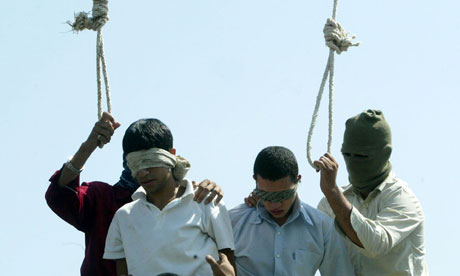
Blindfolded Mahmoud Asgari, 16, left, and Ayaz Marhoni are publicly hanged in Mashhad, Iran, in 2005 on charges related to sodomy.
Homosexuals are inferior to dogs and pigs, says Iranian cleric
The Guardian (UK)
An influential Iranian cleric who is entitled to issue juristic rulings according to the Sharia law, has condemned western lawmakers involved in the decriminalisation of homosexuality, saying those politicians are lower than animals.
"If a society commits a new sin, it will face a new punishment," he said while interpreting Qur'anic verses about prophet Lot whose tribe Isalmic scholars say was punished by God for sodomy. "Problems like Aids did not exist before."
Citing the Qur'an, Javadi-Amoli said politicians who pass laws in favour of homosexuals are lower than animals. "Even animals ... dogs and pigs don't engage in this disgusting act [homosexuality] but yet they [western politicians] pass laws in favour of them in their parliaments."
Homosexuality is punishable by death according to fatwas issued by almost all Iranian clerics. Until recently, Lavat (sodomy for men) was punishable by death for all individuals involved in consensual sexual intercourse.
But under new amendments approved recently in the Iranian parliament the person who played an active role will be flogged 100 times if the sex was consensual and he was not married, but the one who played a passive role will still be put to death regardless of his marriage status.
Despite the horrific punishment for homosexuals in Iran, the gay community in the country is alive underground and has won some recognition by coming out in defiance of the regime.
In September 2011, a group of gay, lesbian, bisexual and transgender Iranians launched a campaign on Facebook, highlighting the discrimination against sexual minorities in Iran where homosexuals are put to death.