Tuesday, February 5, 2013

UK links

From the Teaching Comparative blog. I highly recomend Ken Wedding's review book.

If you're not in touch with the Facebook group for Comparative Government and Politics, I have posted a number of links about the UK recently. Thanks to Ken Halla and Rebecca Small for some of the suggestions.

Good stuff.

Don't forget about the fabulous book I publish and sell.


GB's Supreme Court


Would have been nice to have this post before the test, wouldn't it? Oh, bother. "Well, it's better than a poke in the eye with a blunt stick."

Thanks to my colleague Rebecca Small f(and US Government Teachers Blog) for this site on Great Britain's Supreme Court and for the video about the 2009 addition of it.

So for a regained point, blog here the correct answer to the question:

The creation of a new Supremem Court in the UK in 2009 replaces the previous judicial review of:

A) The House of Commons
B) Local, devolved constituency courts
C) The House of Lords' role as the highest appeal court in the UK
D) Inturpretation of common law and historic documents like the Magna Carta in reviewing British law
E) Having Lords sit in review of British law.


Monday, February 4, 2013

NHS review


Start at 2:45, watch till 12;45 (THANKS pbs, APGOV.ORG)

Watch Sick Around the World on PBS. See more from FRONTLINE.
Some more information about NHS.
•Total annual cost = approximately £100b. Per resident - £2,000
•Used by 92% of residents (some people have private insurance and use private doctors)
•Healthcare is available to any resident of England (Scotland/Northern Ireland/Wales have their own version of the NHS)
•Most services are free (not even a “co-pay”). There are charges for eye tests, dental, prescriptions, and “personal care.” Each prescription costs £7 (children and 60+ exempt).
•General Practitioners are “gatekeepers.” If you want to see a cardiologist, you have to see your GP first and then she recommends one to you. If she doesn’t recommend you see one, you pay your own way or don’t go.
•Ever since 1948, MPs work to “modernize” and “streamline” the NHS

1. Which of the following is NOT true about the NHS
A. NHS is paid for by taxes.
B. Doctors are government employees.
C. Was established as part of the Collectivist Consensus by the Beveridge Report.
 E. NHS covers preventative, emergency, essential, and elective care.
F. Doctors are incentivized to promote healthy lifestyles.

On Test Tomorrow.....The Fix

Houses of Parliament Last September, Deputy Prime Minister Nick Clegg did get a bit of electoral reform when hereditary peers in the House of Lords, after delaying action twice, agreed to pass the Fixed Term Parliament Act of 2011. The BBC reported:
 
The Fixed-Term Parliaments Bill finally cleared the House of Lords when peers, who had twice blocked the plan, accepted a compromise proposal.

They wanted the law to be renewed after each election but ministers said that meant allowing fixed terms to be switched on "like a light switch".

Peers voted by 188 to 173 to accept a plan for a review in 2020.

Parliaments are currently limited to a maximum of five years, but the prime minister is free to call a general election at any time.

The government has argued that fixed terms would eliminate the power of the executive to call elections when it was politically convenient - but their choice of a five-year, rather than a four-year term drew criticismAnd some peers had argued that the coalition did not have a mandate to "bind" future parliaments.
They put forward plans that would in effect have required each new parliament to decide whether it wanted a fixed term.

Peers had twice backed a "sunset" provision that would have given both the Commons and the Lords the chance to choose whether to renew the legislation after each general election
.
Crossbench peer Lord Butler urged peers to stand firm and said the government's offer, to set up a review in 2020, was an "insult". And fellow crossbencher Lord Pannick said: "The proposal is not so much kicking the issue into the long grass as burying it in a time capsule."

But peers voted, by a majority of just 15, to back the government.

Advocate General Lord Wallace said any future government could choose to repeal the fixed-term legislation - but that would be the "subject of full parliamentary scrutiny as this Bill has been".
"By contrast the sunset amendments would switch fixed terms on and off like a light switch. Parliaments would default to non-fixed terms if a simple resolution fails to be tabled or if the two houses cannot agree on the matter."

The bill will now be sent for Royal Assent. (to become law)

Under the bill an election could still be triggered before the end of a five-year term if a motion of no confidence was passed in the government and no alternative administration could be formed, or if at least two-thirds of MPs approved calls for an early election.

The process of how a bill becomes a law in the UK can be seen here by the bill's flow:

Fixed Term Parliament Act of 2011

So by the Act, now instead of waiting for the PM to call an election date within 5 years, the 2015 UK election date is set for 7 May 2015.

_____________________

Also more on Quango's (thanks to apgov.org)

Quasi means kinda-sorta
Autonomous means self-governing
NGOs are Non Governmental Organizations

A hypothetical example of a QuANGO
It's a good thing for the British economy if people purchase British wool. Instead of the government taking on this job and making already large bureaucracies even larger, they allocate some money and staff to create a Wool Development Council.

It's kind of like outsourcing bureaucratic work.

The Wool Development Council partnerships with local wool producers who are more than happy to help influence how the government's money is spent on promoting their industry.

This council doesn't report the Agriculture Ministry and likely makes rules about wool regulation, licensing of sheep, and maybe even creates an advertising campaign to make woolen goods the quintessential tourist purchase when people visit England.

QuANGOs have been popular because they can "punt" responsibility down to others and aren't accountable for poor decisions. On the opposite side of the coin, people don't like them because their heads aren't elected and so they have little accountability.

In 2010 the British Government said it had earmarked (chosen) nearly 200 quangos for closure, and 120 more for merging. In August 2012, the government said that 106 quangos had lost their public status since then. Some were axed, some were sold off, and some had their work done elsewhere.

According to Wikipedia, in the year 2006-07, tax payers funded 1,162 QuANGOs at a cost of nearly £64bn; equivalent to £2,550 per household.
If you're still confused, let the BBC try to explain it to you.

Wednesday, January 30, 2013

Guardian Series on the EU....Good Stuff!

As The Guardian writes, "The European Union is grappling with its deepest crisis in 60 years, a malaise that goes beyond the euro debacle and the enormous tide of debt swamping the continent. The union seems exhausted. Expansion has ground to a halt. Sluggish EU economies are being eclipsed by rivals in Asia and Latin America. "Brussels" has become a dirty word, no longer only in Britain...

"At this critical juncture, six leading newspapers from the largest EU countries have come together in a joint project to build up a more nuanced picture of the EU and explore what Europe does well and what not so well.

"We begin by investigating the benefits the EU has brought to 500 million people and later today examine the national leaders labouring to steer it out of its current difficulties. Tomorrow we look at euroscepticism and national stereotyping. At the end of the week, you can take our "How European are you" test and see how you and other European readers rank."

The series' home page at The Guardian is at

http://www.guardian.co.uk/world/series/europa

The College Board's article on the Challenges of EU enlargement is linked here (thanks to apgov.org)

Challenges of EU Enlargement

The Pint: A battle EU supporters couldn't win

A classic blurb re-run to teach about the European Union and its struggles when its bureaucratic rules, backed up by legislation from the European Parliament, challenge national sovereignty, sparks fly. What's a sovereign nation to do?In this, the latest example involving the EU and its members, the EU bureaucrats, using their wide range of discretion, seem to have backed down.

The defenders of pints, miles, and pounds (as weight, not money) are not entirely satisfied. By the way, those of us not in the UK (or the Republic o Ireland) might not understand that the pint is the most important of these traditional measures.

EU gives up on 'metric Britain'


The European Union is set to confirm it has abandoned what became one of its most unpopular policies among many British people."It is proposing to allow the UK to continue using pounds, miles and pints as units of measurement indefinitely..."Under the plans which have now been scrapped, even displaying the price of fruit and vegetables in pounds and ounces would have become grounds for a criminal prosecution."The decision to back down was made by Industry Commissioner Guenter Verheugen... 'I want to bring to an end a bitter, bitter battle that has lasted for decades and which in my view is completely pointless.


Bono: EU definition lies eight miles away


http://www.time.com/time/magazine/article/0,9171,1601932,00.html

(Sustainable development in Africa may be one the topic choices for our final exam project. Following the lead of my favorite rock star when he read the founding document of the EU, the Treaty of Rome, 2007, we will consider the EU's role in Africa here in this re-run post.)

In saying the West’s (particularly Europe’s) greatest depends on how it deals with Africa, Bono wrote in an essay in Time Magazine:

“Fast-forward 50 years. An Irish rock star reads the treaty with the enthusiasm a child has for cold peas but does uncover what I think technocrats might call poetry. Not much of it--just a turn of phrase here and there. Like Article 177, which summons the signatories to foster "the sustainable economic and social development of the developing countries and more particularly the most disadvantaged among them" and calls for a "campaign against poverty in the developing countries." Not exactly Thomas Jefferson but a glimpse of the kind of vision that might bind us.

Over the next 50 years, we might need a little more poetry. Europe is a thought that has to become a feeling--one based on the belief that Europe stands only if injustice falls and that we find our feet only when our neighbors stand with us in freedom and equality. Our humanity is diminished when we have no mission bigger than ourselves. And one way to define who we are might be to spend more time looking across the eight miles of Mediterranean Sea that separates Europe from Africa.

There's an Irish word, meitheal. It means that the people of the village help one another out most when the work is the hardest. Most Europeans are like that. As individual nations, we may argue over the garden fence, but when a neighbor's house goes up in flames, we pull together and put out the fire. History suggests it sometimes takes an emergency for us to draw closer. Looking inward won't cut it. As a professional navel gazer, I recommend against that form of therapy for anything other than songwriting. We discover who we are in service to one another, not the self.

Today many rooms in our neighbor's house, Africa, are in flames. From the genocide in Darfur to the deathbeds in Kigali, with six AIDS patients stacked onto one cot, from the child dying of malaria to the village without clean water, conditions in Africa are an affront to every value we Europeans have ever seen fit to put on paper. We see in Somalia and Sudan what happens if more militant forces fill the void and stir dissent within what is, for the most part, a pro-Western and moderate Muslim population. (Nearly half of Africa's people are devotees of Islam.) So whether as a moral or strategic imperative, it's folly to let this fire rage.”

The entire text of Bono’s essay is linked at the top. You, of course, can refer back to http://www.data.org/ for more information. The ONE Campaign is an example of a grassroots (really netroots) linkage institution.

As a group, the EU countries have committed 0.7% of GDP to help the poorest of the poor. So far, as the saying goes the check is, well, in the mail. At the end of the essay, the songwriter pens, “What will define Europe in this new era…..Part of the answer lines eight miles away.”

If only it could become a hit.

Tuesday, January 22, 2013

AV vote was "bitter blow for people who believe in the need for political reform."


In just the second UK-wide referendum in history over the Alternative Vote, the UK voted overwhelmingly last May to reject changing the way MPs are elected - dealing a bitter blow to Nick Clegg on top of heavy Lib Dem poll losses. It was clear British voters chose to ignore process, wanting the government to focus on progress. Deputy Prime Minister Nick Clegg, and the Lib-Dems the strong supporters of electoral reform, also felt his side felt the wrath of voters' backlash of austerity measures. The BBC reported:


Officials say 19.1m people voted in the second UK-wide referendum in history - a higher than expected turnout of 41%.

The final result put the Yes vote at 32.1% and the No vote at 67.9%.

It comes as the Lib Dems suffered a rout in English local elections - and the SNP scored an historic victory in the Scottish Parliament poll.

A debate that was often about the complexity of electoral systems ended in the simplest of results.


The No campaign won, overwhelmingly.

The rush to attribute blame, or grab the credit for that result, begins here.

Those who favoured the Yes campaign will argue they were defeated by the Prime Minister's campaigning power, a largely hostile press and a tough opposing campaign.

Those who backed a No vote will say they won the argument for the merits of the status quo, and persuaded people the alternative vote was complex and unnecessary.

The voters, of course, needed only to mark crosses on ballot papers. They did not have to explain their reasoning.

So campaigners who devoted months of their lives to this argument will never know what difference, if any, they made to the result.

Read Ross's thoughts in full

Bitter blow for Clegg, Lib-Dems


Monday, January 21, 2013

Words to live by?

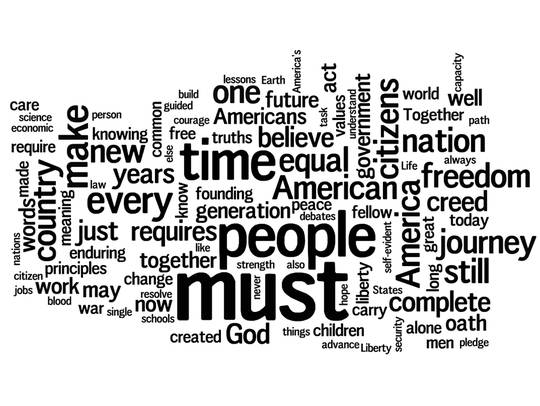
President Obama delivered his second inaugural address Monday. Below, a word cloud showcases the top 100 words in Obama's speech, with "must" and "people" taking the top spots. Obama started many phrases with "We, the people."  


_______________
____________________________________

Speech Was 'So Gay' It Was Historic
President Barack Obama on Monday became the first president to use the word “gay” in an inaugural address in reference to sexual orientation, making two references to gay rights as he began his second term.

“Our journey is not complete until our gay brothers and sisters are treated like anyone else under the law — for if we are truly created equal, then surely the love we commit to one another must be equal as well,” Obama said during his speech.


Read more: http://www.politico.com/story/2013/01/first-inaugural-use-of-the-word-gay-86499.html#ixzz2IfCoKbld